December 19, 2025
The Evolution of Bad Habits
And Why They’re Easy to Make—and So Damn Hard to Break
We tend to talk about habits today as if they’re some modern inconvenience.
Something we need to hack, trick, optimize, or out-smart.
That framing is wrong.
Habits aren’t the problem.
They’re one of the great survival technologies of the human species.
Long before habit trackers, productivity apps, or books with numbers in the title, habits existed for one reason:
Not dying.
If a particular sequence of behaviors led you to honey instead of hunger…
If a certain tracking strategy led to meat instead of exhaustion…
If a specific response kept you alive when a wild animal charged…
You would be an idiot not to lock that pattern in. And that’s exactly what the human nervous system learned to do.
Habits are not laziness.
They are stored success.
From an evolutionary perspective, repetition was never the goal.
Reliability was.
Once something worked, the body asked a very simple question:
“Why would I improvise this again?”
So it saved the behavior as a routine.
Not because it was optimal forever.
Because it worked then.
The Flawed Question We Keep Asking About Habits
There’s a lot of discussion today about how long it takes to form a habit.
15 days.
21 days.
66 days.
James Clear’s Atomic Habits—which I genuinely admire—touches on this question, often referencing a 2009 study by Phillippa Lally at University College London. That research showed that habit automaticity varies widely, averaging about 66 days, with a range from 18 to 254 days.
Interesting. Useful.
And… fundamentally incomplete.
Because time is not the primary driver of habit formation.
Emotion is.
More specifically: emotional intensity.
Why One Moment Can Create a Lifetime Habit
Let me give you a simple example.
A rookie athlete plays the game of their life.
Final seconds.
They score the winning points of a championship game.
The crowd erupts.
Teammates swarm.
Family cries.
Identity shifts.
That single moment carries enormous emotional charge.
What happens next is fascinating—and completely predictable.
The athlete looks backward.
What did I eat that morning?
What was I wearing?
How did I lace my shoes?
Did I do anything unusual before the game?
And suddenly:
A “game-day breakfast” is born
Lucky socks appear
Shoes must be tied just so
Rituals form, sometimes bordering on the absurd
Not because those behaviors caused the win.
But because the nervous system associates emotional intensity with survival-relevant success.
Neuroscience supports this clearly. Emotionally charged experiences activate the amygdala, which strengthens memory consolidation in the hippocampus (McGaugh, 2004). Put simply:
The stronger the emotion, the fewer repetitions required.
One moment can be enough.
The Survival App Running Quietly in the Background
There’s another instinct at play here—one I often describe as an ancient internal app.
It runs quietly, constantly, and unquestioned.
It says:
“If I’m alive today, whatever I did yesterday must have been good.”
For most of human history, survival was anything but guaranteed.
So continuity mattered.
If yesterday’s behaviors didn’t kill you, the safest strategy was to repeat them.
This is why habits lock in so quickly once they start:
Day one → survival
Day two → confirmation
Day three → automation
Not because it’s wise. Because it’s safe.
The Real Problem: Reward Without Risk
Here’s where things get interesting.
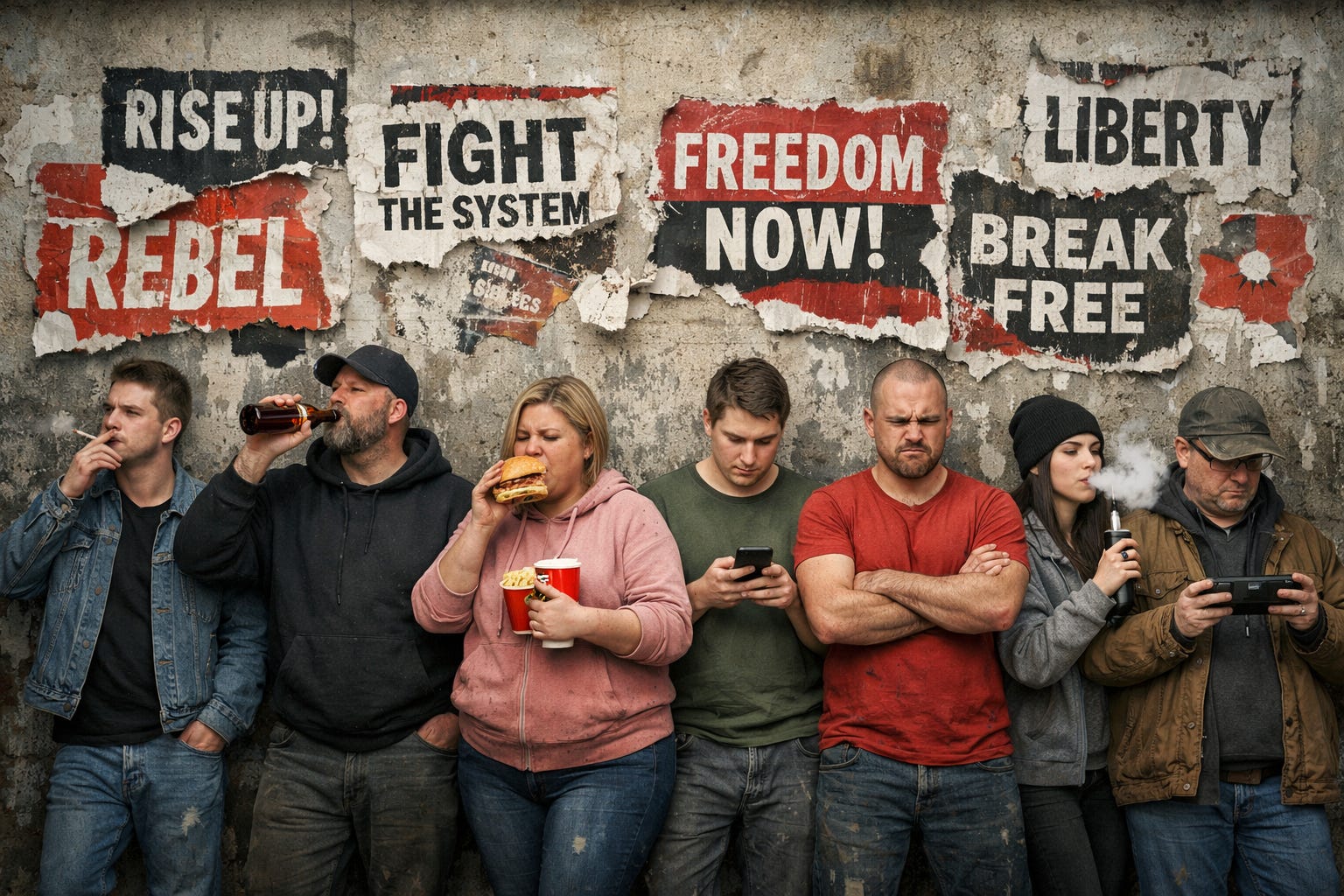
One of the great difficulties we face today is that habits are locked into emotional reward systems—and modern life is overflowing with super-stimuli.
Quick dopamine from social media.
Hyper-palatable foods engineered to hit bliss points.
Feel-good substances.
Infinite novelty.
Constant validation.
In ancestral environments, reward was scarce and effortful.
Today, reward is instant, exaggerated, and disconnected from survival value.
The brain doesn’t know that.
Dopamine is dopamine.
So behaviors that would never have existed long enough to become habits in an ancestral environment now lock in with frightening speed.
And once locked in, they don’t feel wrong.
They feel familiar.
Which is far more dangerous.
Where the Evolution Gap Shows Up
This is the Evolution Gap in action.
Ancient systems—designed for scarcity, danger, and uncertainty—are now operating in an environment of:
Artificial stimulation
Hyper-palatable food
Infinite novelty
Near-guaranteed survival
Modern emotional intensity doesn’t come from escaping predators.
It comes from:
Sugar + fat + salt
Likes, shares, and notifications
Doom scrolling
Pornography
Online outrage
Constant comparison
Our nervous system doesn’t know the difference.
Intensity is intensity.
And so we end up with “bad habits” that are incredibly easy to form…
and brutally hard to break.
Not because we’re weak.
But because we’re human.
Why Willpower Fails (Almost Every Time)
When people decide to quit a habit, they usually do it the same way:
An explosion of willpower.
A declaration.
A moment of force.
Sometimes that force lasts minutes.
Sometimes hours.
In the case of diets, about a week on average.
This isn’t a moral failure.
It’s a misunderstanding of how behavior works.
Willpower is useful for decisions.
It’s terrible for transformation.
Research on self-control (Baumeister et al.) shows that effortful inhibition is metabolically and emotionally expensive. You can use it to turn the wheel—but not to rebuild the engine.
Yet this is the strategy we keep using.
Over.
And over.
And over.
Education Isn’t Transformation (And Never Was)
When I first stepped into teaching and coaching, I made a discovery that changed everything for me:
Education and transformation are often completely unpaired.
Some of the most educational experiences in life aren’t transformative at all.
And some of the most transformative experiences—
climbing a mountain
walking on fire
going through a divorce
aren’t educational in any formal sense.
Transformation happens when emotional relevance, identity, timing, and meaning converge.
So I set out to bridge that gap.
Behavioral Change Dynamics
That search led me to develop what I now call Behavioral Change Dynamics—a methodology for designing experiences that don’t just inform, but re-pattern.
It’s the engine behind:
Live retreats
Seminars
Digital programs
AI-driven coaching systems
And most visibly, behind WILDFIT.
Over the last decade, WILDFIT has served more than half a million people, helping them change their relationship with food, reverse diabetes, end obesity, and dramatically improve their health.
The surprise wasn’t that the information worked.
It was that people actually used it.
That’s the real miracle.
Because information without behavioral stickiness does nothing.
Why People Get Stuck Trying to Stop
In studying behavior change, one pattern became impossible to ignore:
People aren’t bad at stopping habits.
They’re bad at stopping them the wrong way.
Over time, I identified four dominant stopping styles—four emotional strategies through which people naturally succeed at cessation.
Most people are strongest in one.
The Four Stop Styles
Pioneers – Driven by novelty and identity shifts
Connectors – Driven by social context and accountability
Builders – Driven by structure, systems, and process
Analysts – Driven by logic, evidence, and coherence
When someone tries to stop a habit using a strategy misaligned with their nature, it feels exhausting.
When they use the right one, it often feels… strangely easy.
That insight led to the creation of the Stop It Profile.
Off-Ramps: Where Change Actually Happens
Behavior doesn’t happen all at once.
It unfolds in a chain:
Emotion → Thought → Micro-decision → Action → Justification
Within that chain are off-ramps.
Moments where awareness can be injected.
Not with force.
With recognition.
Identifying off-ramps allows people to interrupt habits they’ve had for decades—without shame, guilt, or self-attack.
And that part matters.
Guilt Is a Trap, Not a Tool
If you’re stuck in a habit—food, scrolling, spending, anything—it’s important to understand this:
On some level, your body believes the habit serves you.
Approaching it with guilt only reinforces the behavior.
Lower self-esteem doesn’t create change.
It creates safety-seeking.
Instead, we approach habits with respect.
Not because they’re good.
But because they were once protective.
And may now be outdated.
Awareness Is the Gateway
Once we recognize:
“If I did it yesterday and I’m alive today, of course I’ll do it again tomorrow”
We can drop the judgment.
And from that place—
with the right stop style
and clearly identified off-ramps—
behavioral change becomes not just possible…
but often surprisingly simple.
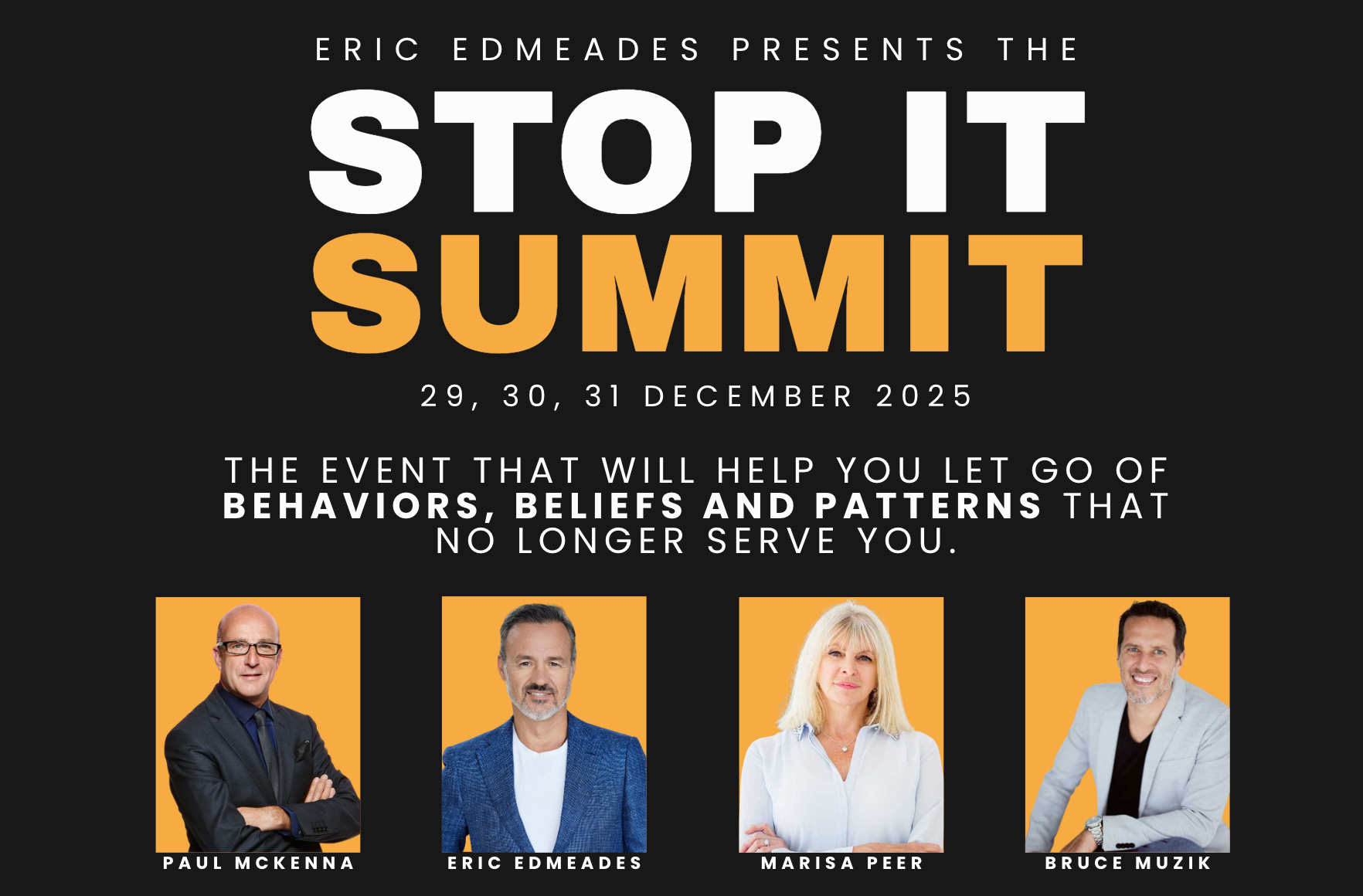
If you have some behavior, habits, or beliefs that you would like to stop, join me for the Stop It Summit online this December.
And from there, we stop fighting habits…
and start outgrowing them.