April 21, 2026
The Evolution of Food Noise
Why almost everyone has low-grade multiple personality disorder when it comes to food.
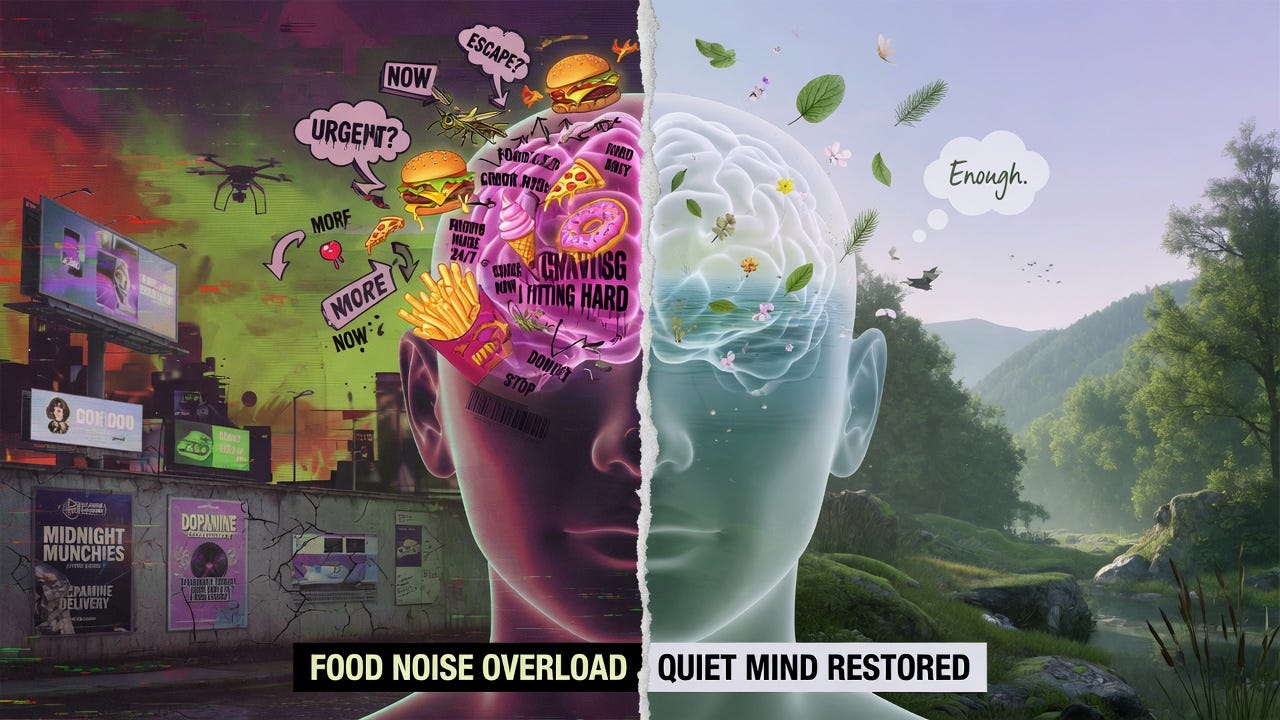
There’s a phrase that’s quietly entered the conversation about weight, eating, and addiction: food noise. It’s the constant, intrusive, exhausting chatter in your head about what to eat, when to eat, what you shouldn’t have eaten, and what you’re going to eat next.
Researchers have now formally defined it as persistent thoughts about food that the person experiences as unwanted and dysphoric, intense enough to resemble rumination. Roughly 57% of people living with overweight or obesity report having it. For decades, those people were told they had a willpower problem.
Thanks for reading The Gap! Subscribe for free to receive new posts and support my work.
They don’t. They have an evolutionary mismatch problem. And at WILDFIT, we’ve been working with food noise for over ten years -- before it had a name, before there was a questionnaire, before the pharmaceutical industry built a multibillion-dollar response to it.
I want to walk you through how we got here. Because food noise didn’t appear out of nowhere. It evolved.
Phase I: Signal
For most of human history, what we now call food noise wasn’t noise at all. It was signal. A clean, one-sided, life-saving signal.
Your stomach emptied. Your blood sugar dropped. A thought arose: find food. You found food. You ate. The thought went quiet. That was the entire system. There was no debate, no shame, no scrolling past temptations on your way to the bathroom. There was only the message, and the response.
The signal had nuance. It got louder when nutrition was scarce and quieter when satiating food filled the body. It got sharper in autumn, when ancient signals still coded into us drive a desire for the dense, sweet, fatty foods that whisper winter is coming, store something. (This is why pumpkin spice everything works. It’s not marketing genius. It’s seasonal biology being read by people who understand it better than you do.)
But here’s the key: there was no opponent in your head. The signal said eat, and you ate, or you didn’t have the option to eat, and the signal eventually quieted while your body lived off its reserves. There was no two-sided argument. There was no noise. There was just the body talking to itself and being heard.
Phase II: The First Argument
Then we invented agriculture. And for the first time in human history, food was something you could store.
This sounds boring. It is not boring. It changed everything. For the first time, a human being had to look at food they were physically capable of eating -- food that was right there, food the body wanted -- and choose not to eat it. Because some of it had to last through winter. Because some of it belonged to the tribe. Because some of it was seed for next year’s planting.
This is where the second voice enters. The instincts say eat what’s in front of you. A new, conscious voice says no, save it. That voice barely existed before, because the situation barely existed before.
Agriculture also gave us a lot more carbohydrate than our hunter-gatherer ancestors had access to, which meant our blood sugar started doing things it had never done at scale. Spikes. Crashes. Phantom hunger. The body’s signaling system, calibrated for one environment, was now operating in another. The signals weren’t lying. They just weren’t accurate anymore.
This is the first real food noise. It’s quiet. It’s manageable. But it’s the beginning of the two-sided argument that would eventually become deafening.
Phase III: The Wealthy Get Sick First
Fast-forward to the agricultural and industrial wealth of the last few centuries. For the first time in history, a meaningful number of people had access to consistent, abundant calories. And they started getting sick in ways that had previously been rare. Heart disease. Diabetes. Gout. The diseases of abundance.
This is when diet culture is born. Not because people suddenly became vain. Because abundance, for a body designed around scarcity, is dangerous, and people started noticing. The wealthy noticed first because they were the first ones with the problem.
Consider William Banting. London undertaker in the mid-1800s. His family business handled royal funerals. He was wealthy enough to be fat in a time when most people couldn’t afford to be. By his sixties he was two hundred pounds at five-foot-five. His eyesight was failing. His hearing was failing. His knees wouldn’t carry him down stairs forwards. His doctor, William Harvey, had just come back from Paris where he’d been attending lectures on diabetes, and he put Banting on a diet that cut out sugar, starch, potatoes, and beer. Banting lost forty-six pounds in a year. His hearing came back. He lived to eighty-one. In 1863 he wrote a small pamphlet called Letter on Corpulence, gave it away for free, and watched it become one of the most widely read booklets of the Victorian era. For a while, to bant meant to diet. In some parts of the world, it still does.
And yet here we are. Why? Not because the diet didn’t work. It worked beautifully for the people who followed it. But because it was a diet. It told you what to eat. It didn’t touch the conversation in your head. It didn’t address cravings, or reward, or the social pull of food, or the engineered availability that was already starting to build around him. Banting solved the eating problem for people disciplined enough to follow him. He didn’t solve the food noise problem, because food noise in 1863 was still a whisper. It hadn’t grown into what it would become.
Now the food noise gets serious. There’s plenty in the cupboard. Your body still wants what it always wanted. But now you know -- or you’ve been told -- that you shouldn’t eat as much as your body is asking for. The argument in your head goes from a whisper to a real conversation. I want this. I shouldn’t have this. But I want it. Maybe just a little. No, none. Okay, half.
This is the first time food noise actually feels like noise. Like an unwanted soundtrack you can’t turn off.
Phase IV: The Hijack
And then we built modern food.
Hyperpalatable engineered products designed by some of the smartest people on earth, with one job: to be impossible to stop eating. Marketing campaigns built on neuroscience, designed to install cravings into children before they’re old enough to spell their own names. A food environment in which the cheapest, most accessible, most advertised, most convenient calories are the ones most likely to make you sick.
Your body’s signaling system, the one that worked beautifully for two hundred thousand years, is now being deliberately exploited. Sugar combinations that don’t exist in nature. Fat-and-salt-and-sugar ratios that hijack reward circuits. Textures engineered for what food scientists call “vanishing caloric density,” which is a polite way of saying we made it disappear in your mouth so you’d eat more of it.
And now the food noise is screaming.
This is where most people are living. And then we tell them, with a straight face, that they need more willpower.
What I Learned From the Hadza
I’ve been visiting the Hadza in Tanzania for fifteen years, sometimes embedded for up to two weeks at a stretch. On one of my early visits, I traveled in deliberately without bringing food, because I wanted to know what would happen.
The first day was uncomfortable. The second day was worse. My cravings amplified. My head was full of noise: imagined meals, remembered meals, plans for the meals I’d have when I got home. My body was making the case it had been trained to make in a world of constant abundance.
And then, by the third day, it stopped.
Not the hunger. The hunger was still there, on and off, the way hunger is supposed to be. But the noise was gone. There was no debate, no rumination, no fantasizing. When food was available -- meat from a hunt, berries, tubers, honey -- I ate, and it was extraordinarily satisfying. When it wasn’t, I went about my day. The reward signals around eating were powerful and clean. There was no argument because there was nothing to argue with.
Food noise, I realized, is also driven by opportunity. Take the opportunity away, and the argument has nowhere to go. The Hadza weren’t disciplined. They were undistracted. There’s a difference, and it matters.
You and I don’t live with the Hadza. We live in Phase IV. But that experience taught me something important: the noise is not native to the human mind. It’s the predictable output of a body designed for one environment trying to operate in another. Which means it can be quieted. Not perfectly, not always, but meaningfully.
What We’ve Learned at WILDFIT
Over those years of working with people trapped in food noise, our approach has come down to a few principles. None of them are exotic. All of them work.
First, increase the consumption of genuinely satiating foods. Real protein. Real fat. Real fiber. Foods the body recognizes and knows how to respond to. When you eat food that actually satisfies, the signal does what it’s supposed to do: it goes quiet.
Second, reduce the consumption of foods that trigger hunger rather than satisfy it. There’s an entire category of food -- and you know which ones -- that leaves you hungrier after eating it than before. These foods are in your house because someone designed them to be in your house. Get them out.
Third, reduce the foods that crash your blood sugar. Every crash is a false alarm telling your body it’s starving when it isn’t, and your body responds with cravings that feel like real hunger but aren’t. You’re not weak. You’re being lied to by your own bloodstream, and the lie was installed by what you ate three hours ago.
And fourth, bring consciousness to the conversation. Because once you understand what food noise actually is -- where it comes from, what’s amplifying it, why it sounds the way it does -- it loses an enormous amount of its power. You can listen to it differently. You can ask it questions. You can recognize, in the moment, that the voice screaming for the cookie isn’t your hunger. It’s an echo of an environment that was engineered to produce exactly this experience.
This is slow work. It’s not glamorous. It doesn’t fit on a magazine cover. But it works, and the people it works for don’t need it to work again next year, because they’ve actually changed.
The Shortcut
Now we have GLP-1 receptor agonists. Semaglutide, tirzepatide, the rest. I want to discuss what they do, because they do some pretty powerful things.
They work. They really work. They slow gastric emptying. They modulate blood sugar. They appear to act directly on the reward circuits in the brain that food noise lives in, not just the stomach. In one large self-reported survey, 62% of patients said they’d had constant food-related thoughts before starting semaglutide. On treatment, only 16% did. For people who have carried that noise for decades, who have been told again and again it was their fault, the relief these drugs bring is hard to overstate. That is a real reduction in real suffering, and I’m not going to pretend otherwise.
In an emergency, paired with serious nutritional work and real psychological coaching, they have a place. As a tool to quiet the storm long enough to do the actual work, they have a place. As an optimization for someone already doing the deeper work, fine.
But that is not how they’re being used. They’re being used to fix the problem. And they don’t fix the problem. They mask it.
When you stop taking them, the body comes back. In the STEP 1 extension trial, patients regained two-thirds of their lost weight within a year of stopping. The cardiometabolic benefits reverted. Because nothing was solved. The food environment didn’t change. The blood sugar dysregulation didn’t change. The relationship with food didn’t change. The only thing that changed was that, for a while, a drug was holding the line.
And now we get to the part nobody wants to talk about.
The Muscle You Don’t Build
Food noise is, at its core, a battle between executive function and instinct. Between the part of you that knows what you want over the long term and the part of you that wants what it wants right now. That argument is not a defect. It’s how the human prefrontal cortex matures. It’s how self-regulation gets built.
There’s a region of the brain called the anterior cingulate cortex -- specifically, the anterior midcingulate -- that lights up when you do something you don’t want to do, or refuse to do something you do want to do. Neuroscientists studying willpower describe it as the brain’s effort and salience hub, the place where the cost of resistance is computed and paid. Use it, and it strengthens. Don’t use it, and it doesn’t.
A few years ago I started doing cold plunges. The first one was a revelation. Standing at the edge of that water, I could feel two voices in my head with absolute clarity. There was a higher voice that said: this is good for you, this is what you said you’d do, get in. And there was a much louder voice -- the body, the survival circuitry, the lizard -- that said: under no circumstances are you getting in that water.
It took everything I had to override the second voice and get in. Then it took everything I had to stay in. After about thirty or forty seconds, something shifted. The body relaxed. The argument stopped. The captain and the crew aligned, and what had been a war became a practice.
The next plunge was easier. The one after that, easier still. Not because the water got warmer, but because something in me got stronger. The anterior cingulate gets stronger with use, yes. But more than that: the body learns to trust the captain. The internal argument loses some of its volume because the part of you that used to win every argument has started to lose some of them, and has started to remember that losing didn’t kill it.
This is what’s at stake with the GLP-1 shortcut. When you medicate the argument away, you also medicate away the practice. The muscle doesn’t get built. And worse: a muscle that isn’t used atrophies. So at minimum, the patient on these drugs misses years of practice they could have spent developing real self-regulation. At maximum, they end up with less of it than they started with, which means they need the drug for life, because they no longer have the internal capacity to do the work themselves.
Used this way, that’s not treatment. That’s dependence dressed up as treatment.
Where This Leaves You
Food noise is real. It is not your fault. It is the predictable consequence of a body designed for one world being asked to live in another, in an environment where powerful interests profit from your confusion.
But it can be managed. Not perfectly, not painlessly, but really. By eating food your body recognizes. By removing the foods engineered to trick you. By stabilizing the blood sugar that’s lying to you. And by bringing consciousness to the conversation, so that when the voice in your head starts screaming, you can recognize it for what it is: not the truth, just an echo.
A drug that quiets the noise without teaching you anything is not a solution. It is a crutch. And a crutch you have to use forever isn’t help. It’s capture.
You can do this work. The fact that the argument is hard is not evidence that you’re failing. It’s evidence that you’re the first generation in human history being asked to have it on this scale. Have it anyway. Build the muscle. Get the captain and the crew aligned. That’s where freedom actually lives.
So here’s the real question. Do you want a real solution to the problem, or do you just want to stick your finger in a crack of the obesity dam?
References
Dhurandhar, E. J., et al. (2025). Food noise: definition, measurement, and future research directions. Nutrition & Diabetes. (Formal definition; RAID-FN Inventory.) nature.com/articles/s41387-025-00382-x
Knop, F., et al. (2025). INFORM survey results presented at EASD 2025, Vienna. (62% pre-treatment vs 16% on semaglutide reporting constant food thoughts; n=550.) eurekalert.org/news-releases/1098257
Wilding, J. P. H., et al. (2022). Weight regain and cardiometabolic effects after withdrawal of semaglutide: The STEP 1 trial extension. Diabetes, Obesity and Metabolism, 24(8), 1553-1564. doi.org/10.1111/dom.14725
Conceptual review on GLP-1s, the default mode network, and food noise. PMC, 2025. pmc.ncbi.nlm.nih.gov/articles/PMC12770913
Clay, J., et al. (2022). Training Willpower: Reducing Costs and Valuing Effort. Frontiers in Neuroscience. (aMCC, salience network, effortful control.) frontiersin.org
Banting, W. (1863). Letter on Corpulence, Addressed to the Public. London. Full text via Internet Archive.
Thanks for reading The Gap! Subscribe for free to receive new posts and support my work.